Wednesday, December 30, 2020

12:28 AM

Missing ITR filing deadline on Dec 31 will attract penalty twice that of last year

 One important difference between missing the ITR filing deadline last year and missing it - December 31 - this year is that you will have to pay a penalty of Rs 10,000 this time, unlike last year when the penalty for belated ITR filing within a few months of missing the deadline was only Rs 5000. However, this penalty or late filing fee will only be applicable if your net total income (i.e. income after claiming eligible deductions and tax exemptions) exceeds Rs 5 lakh in the financial year for which the ITR is being filed. If your net total income does not exceed Rs 5 lakh in the financial year, then late filing fee will be Rs 1,000.


The normal deadline to file Income Tax Returns (ITRs) for an individual is July 31 every year. If you miss the deadline and file a belated return by December 31 of the same year, then the late filing fee is Rs 5000. If you file, the belated return after December 31 but before March 31 of the relevant assessment year then the late filing fee is Rs 10,000. As the time period between July to December 31 would already be over once the new deadline of December 31 is missed therefore the higher penalty of Rs 10,000 would automatically become applicable.

Chartered Accountant Naveen Wadhwa, DGM, Taxmann.com says, "As the due date (for ITR filing) has been extended to December 31, 2020, the late filing fees of Rs. 5,000 shall not be applicable because it is charged if return is furnished after the due date but before December 31 of the relevant assessment year. Thus, an ITR filed between January 2021 and March 2021 will be termed as belated ITR for FY 2019-20 and will attract a late fee of Rs 10,000, if applicable."

Corroborating the view, Abhishek Soni, CEO & founder, Tax2win.in, an ITR filing website says, "This is because no change has been made in section 234F of the Income-tax Act. Under this section, there is a two-tier structure of levying late filing fee on belated ITR filing."

A late filing fee under section 234F is usually levied as follows:
a) Rs 5,000 if the ITR is filed after the expiry of the deadline but on or before the December 31
b) Rs 10,000 if the ITR is filed between January 1 and March 31.
However, for small taxpayers whose total income does not exceed Rs 5 lakh, then late filing fee of Rs 1000 is levied.

Even individual taxpayers whose income is above the exemption limit but have already paid their entire tax due will have to pay the penalty as applicable if they file a belated ITR i.e. after the December 31 deadline.

Levying of late filing fee on belated ITR was announced in Union Budget 2017 and became effective for the income tax returns filed for FY 2017-18 onwards.

What if income is below exemption limit
Effective from FY 2019-20, ITR filing is also mandatory if you meet certain conditions, even if your gross total income is below the basic exemption limit i.e. there is no tax liability. These conditions are:
a) If you have spent Rs 2 lakh or more on foreign travel on self or any other person in the relevant financial year;
b) If you have paid an electricity bill of Rs 1 lakh or more in the relevant FY; and
c) If you have deposited Rs 1 crore or more in one or more current accounts maintained with a bank or co-operative bank.

In such cases, if ITR is not filed before the expiry of deadline i.e. December 31, 2020, then late filing fee will be levied on filing a belated ITR. However, the fee amount will not exceed Rs 1,000 in such cases. On the other hand, if ITR filing is not mandatory under the income tax laws, then no penalty will be levied even if the ITR is filed after the due date.
12:23 AM

Mumbai: 34 years later, 800 flat-buyers get Rs 24 crore back

 (This story originally appeared in  on Dec 29, 2020)

MUMBAI: In a long-drawn legal battle with a builder, around 800 buyers, who booked flats in an affordable housing scheme in Virar in 1986, finally started receiving refund cheques totalling Rs 24 crore.

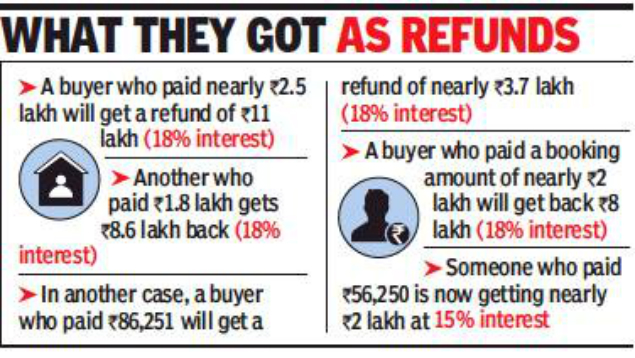
Over three decades ago, they had paid builder, Paranjape Construction, Rs 1 lakh to Rs 11 lakh for homes at the J P Nagar project at Kofrad village, Virar.
refund gfx

The developer completed some buildings but was unable to finish the project, forcing stranded purchasers to approach the consumer court from 1998. They were represented by the consumer rights group, Mumbai Grahak Panchayat (MGP).

Following a national consumer disputes redressal commission court order in favour of buyers in 2012, the builder’s land was auctioned for Rs 24 crore that year but he challenged the auction in Bombay high court. The HC did not stay the auction but directed that money not be disbursed to the buyers till the final order. In February 2019, the court ordered that the amount be paid to the buyers. But due to parliamentary and assembly elections, the local collector’s office was unable to start the process. Early this year, the pandemic lockdown further delayed the payment.

Recently, Vasai tehsildar Ujwala Bhagat transferred the amounts to Bandra Consumer Commission’s office for disbursal to the buyers. “We started returning the money two months back,’’ she said.

“It is a historic and landmark case where 800 home-buyers led by MGP fought against the builder. This case speaks volumes about the very poor functioning of consumer courts, which are expected to redress consumer grievances in three to five months. During this long period, few purchasers expired,’’ MGP chairman advocate Shirish Deshpande told TOI. “Most buyers had given up hope of getting their hard-earned money but MGP ultimately succeeded in getting it back,’’ he said.

The developer could not be reached for a comment.

In 1986-87, Paranjpae Construction announced an affordable housing scheme in Virar, offering homes at “very reasonable prices’’. Many middle-class families were tempted to book flats/row houses and paid substantial amounts. The developer completed around a dozen buildings and gave possession to buyers. But he was unable to finish the entire project, leaving 800 buyers in the lurch. MGP filed cases in consumer courts at the district forum and national commission level on behalf of the buyers in five batches between 1998-2002. The builder was ordered to refund the money along with compensation, but did not comply with orders.

MGP invoked Section 25 of Consumer Protection Act, 1986, and got Paranjape’s property at Virar auctioned through the collector. “The developer challenged the auction in HC in 2012, so money received through it could not be paid to the buyers. After seven years, the HC dismissed Paranjape’s challenge, observing that there was no irregularity in the auction and cleared the way for a refund,’’ said MGP secretary Anita Khanolkar.
12:06 AM

More market holidays & extended weekends for Dalal Street in 2021

Calendar 2021 will have 14 market holidays, including five extended weekends because of a holiday falling either on Friday or Monday, data compiled from BSE suggests. The list counts the special shortened one-hour ‘Muhurat trading’ session on Diwali as a market holiday.


Calendar 2020 had fewer market holidays at 12, but more extended weekends at nine.


The first holiday for the bourses in 2021 would be on January 26, a Thursday, when the market would be shut for Republic Day. Bourses would observe no holidays in February and June.


There are two market holidays in March – Mahashivratri on March 11 and Holi on March 29. Holi, in this case, would be an extended weekend, as the holiday falls on a Friday.


April will have three market off days: on April 2 on account of Good Friday, April 14 for Dr Baba Saheb Ambedkar Jayanti and April 21 for Ram Navami.


Eid-Ul-Fitr (Ramzan Id) on May 13 would be the sole market holiday for May, Bakri Id on July 21 for July and Muharram on August 19 for August.


Towards the latter part of the year, Ganesh Chaturthi falls on September 10 and Dussehra on October 15, which would be extended market holidays.


The biggest extended holiday would be during Diwali.


A special shortened trading would take place in an otherwise market holiday on November 4, Thursday, account of Diwali. The market would be shut on November 5, Friday, on account of Diwali Balipratipada, followed by regular trading holidays on Saturday and Sunday. Gurunanak Jayanti would also fall on a Friday, on November 19.


Christmas next year falls on a Saturday, which is a normal market holiday.

12:04 AM

Out of 10 biggest small investor bets, only one shone in 2020; 9 eroded wealth

The biggest bets of retail investors failed to deliver strong returns in Calendar 2020, even when the equity benchmarks are ending the year at record highs.


Investors holding shares worth up to Rs 2 lakh bought additional stakes of 9.5-23 percentage points in 10 of the BSE500 companies during the first three quarters of the year.


All but Laurus Labs delivered poor returns: seven of them ended up eroding up to 77 per cent of investor wealth; two delivered a tepid return of 3 per cent each. In comparison, BSE Sensex gained 15 per cent for the year.


Kishore Biyani’s Future Retail eroded 77 per cent of retail investors’ wealth during the year. Retail investors held 25.09 per cent stake in this company as of September 30 compared with 2.22 per cent held on December 31, 2019. Future Consumer, another Biyani stock, plunged 62 per cent during the year. Retail investors held 20.33 per cent stake in this stock as of September quarter, compared with 6.77 per cent held on December 31, 2019.


In August, Future Group said Reliance Industries, through its retail arm, would acquire the company’s retail & wholesale business as well as the logistics & warehousing businesses on a slump sale basis for Rs 24,713 crore. Amazon, a stakeholder in Future, is looking to block that deal, saying the Indian retailer violated a contract by agreeing to the sale to a rival controlled by billionaire Mukesh Ambani.


Shares of Raymond have slumped 49 per cent so far in 2020. Retail investors raised stake in this diversified firm by 7.63 percentage points to 25.31 per cent from 17.1 per cent. The Raymond group operates across segments such as FMCG, engineering and prophylactics besides in textile and apparel.


“This year was a total washout. I don't think we will meet FY20 levels, but going forward, a lot of companies have reshaped themselves. They have set new benchmarks and there is a lot of opportunities for the companies that survived this pandemic. They will come out much stronger," Raymond's Chairman and Managing Director Gautam Hari Singhania told PTI earlier this month.


Equitas Holdings declined 38 per cent year to date, as SME/MFI businesses faced various challenges at the operating levels in the wake of the Covid pandemic. The stock has recovered strongly in the last two months on faster-than-expected recovery in business.


Indiabulls Housing Finance (down 35 per cent), Chennai Petroleum Corporation (down 16 per cent) and The South Indian Bank (down 11 per cent) are three other biggest retail bets that failed to deliver for the year. Two stocks -- NCC and PTC India -- delivered 3 per cent each, while Laurus Labs delivered a solid 384 per cent return.


Analysts are mixed on Indiabulls Housing Finance. The company has lost mortgage market share in last one year. The housing finance company had a 2.2 per cent market share as of September 2020 compared with 3.7 per cent held in the year-ago quarter. The scrip had one 'buy', one 'underperform' and one 'hold' ratings on the publicly available Reuters Eikon database as of Friday.


South Indian Bank had four 'buy', one 'outperform', two 'hold', one 'underperform' and one 'sell' rating on the same database. CPCL had one 'buy' and one 'outperform' ratings.


NCC, meanwhile, has seen robust order flows so far in FY21, surpassing its annual guidance of Rs 10,000 crore. Its standalone order backlog stood at Rs 28,000 crore in September while the current unadjusted backlog stood at Rs 32,800 crore, 4.7 times the trailing 12-month revenues. Recovery of past dues is seen as a key trigger for the stock. PTC India has one 'buy' and one 'outperform' ratings, as per the Reuters database.


Analysts remain positive on Laurus Labs on superior execution in the antiretrovirals segment, strong chemistry skill set in the contract development and manufacturing business, the addition of new molecules in the API segment and cost efficiencies. Retail holding in this stock stood at 15.89 per cent at the end of September against 6.37 per cent as of December 31.

12:03 AM

Joe Biden sets tone for US-China ties, says coalition needed to confront Beijing

 Washington: Setting the tone for the US-China ties for the next four years, President-elect Joe Biden on Monday said that Washington needs to build a coalition of like-minded nations to confront Beijing.


"As we compete with China to hold China's government accountable for its trade abuses, technology, human rights and other fronts, our position would be much stronger when we build coalitions of like-minded partners and allies that make common cause with us in defence of our shared interests and our shared values," Biden said following his briefing with national security and foreign policy agency review team members.


Under the Donald Trump administration, ties between the two countries had deteriorated over issues such as human rights violations in Xinjiang, encroachment on the special status of Hong Kong, accusations of unfair trade practices by Beijing, lack of transparency concerning the pandemic and China's military aggression in various parts of the world.


Biden said partnering with other democracies on China would "more than double" the US economic leverage over the country.


"We are almost 25 per cent of the global economy on our own, but together with our democratic partners, we more than double our economic leverage," he said.


On any issue that matters to the US-China relationship, Biden said, "We are stronger and more effective when we are flanked by nations that share our vision for the future of our world."


In a bid to meet the security challenges against China and Russia, Biden said the US must make reforms to put itself in the strongest possible position.


"That includes modernising our defence priorities to better deter aggression in the future, rather than continuing to over-invest in legacy systems designed to address the threats of the past," the President-elect said.


"And we need to close the gap between where our capabilities are now and where they need to be to better deter, detect, disrupt, and respond to these sorts of intrusions in the future," Biden added.


Biden is set to occupy the White House in January next year.

12:02 AM

Great potential for earnings upgrade in TCS, Infosys & HCL Tech

 On SBI

SBI has been subjected to all kinds of uncertainties. They had to bail out YES Bank. There was a fear that SBI would probably need to bail out other PSU banks too. Rajnish Kumar, the previous CMD did a fantastic job in guiding SBI through that whole process and now the new CEO is an old hand and knows the system very well, which is very important for a PSU bank and provides some amount of continuity.


We are now entering into a period of peak provisioning. We know the maximum losses that can happen and that helps in provisioning and in the tier I capital ratios and therefore loan growth. When all these things fall into place, then valuations begin to matter. Valuations anyway are on its side as it is an extremely cheap bank. It will do very well in the coming year.


On real estate as a contrarian play

2020 has been pretty much affected by Covid. No sales were possible before the last two months for obvious reasons and now sales have started again as the economy unlocks and people begin to go out. There is a sufficient amount of unsold inventory out there. Companies including DLF have restructured, reduced their debt and are now showing increasing willingness to sell at a lower price than they were holding back in the previous year. This is going to be a big theme and will apply to other sectors as well.


2021 will be a year of transformation and the companies that are transforming themselves such as DLF, will see increased traction.


On how much more can TCS NSE 0.04 % & Infosys NSE 0.81 % go

If you look at the PEs in the context of earnings, these companies are still trading pretty much in the 20s and for an earnings growth which is going to accelerate with good visibility going into the next couple of years, then PEs will look slightly more palatable.


Second, ROEs of these companies have been improving because lower expenses, greater productivity and higher ROE support greater profitability which supports a higher multiple. Against that backdrop, the multiples are clearly fine for the frontline players and companies as big as TCS, Infosys and HCL Technologies NSE 1.53 %. These companies are still growing earnings north of 15% earnings growth and with the potential for a further earnings upgrade.


As I believe that 2021 is the year of transformation, a transformation in the companies’ business model which improves their margins even in a limited sense, will support higher multiples and earnings will come back over the next couple of years. I think IT will make steady 15-20% returns per year going to the next couple of years at least.


On QSR/consumption space

QSR as a space will continue to do very well simply because coming out of the lockdowns, people are increasingly ordering in more or going out. All these factors will help consumption companies. For example, the Burger King stocks were running ahead of themselves in terms of fundamentals. These are great companies with good valuations at the time of listing but Bectors Food now trades at a very high multiple. Easy money has been made in those stocks but on the other hand, Jubilant Foodworks and Westlife still look good. There is still additional room for returns in the coming weeks and months.

Tuesday, December 29, 2020

11:59 PM

US, UK and India should stop believing their own hype

The year 2020 was, by any measure, rich in awakenings and reckonings. None were as earth-shaking as those forced upon the United States, Britain and India.


The pandemic found three of the world’s most prominent democracies shockingly underprepared, governed by leaders as incompetent as they were deluded and encumbered with states that had steadily rendered themselves incapable of performing their most basic duty: protecting human lives.


In each case, stridently advanced claims — whether to be a new superpower (India), to become one again (Britain) or to provide moral leadership to the world (U.S.) — were broken on the wheel of an unforgiving virus.


The socio-economic challenges before these countries suddenly seem immense, greater even than those faced after the calamity of two world wars. The conventional formulas for national uplift — intensified mass production of goods and services — are no longer enough in the age of deindustrialization and climate change. Meanwhile, the promise of the knowledge economy seems largely deceptive.


But a deeper and more intractable, if also intangible, problem lies in the realm of perception. For the pandemic revealed the great and crippling chasm that exists between reality and the images cherished by these countries. A future that represents an appreciable improvement over the present will remain elusive unless the diminished democracies develop less grandiose and more pragmatic self-images.


In the conventional, widely celebrated idea of India, the country brims with democratic virtues and seems destined to outpace China and take its place among the great Western powers. “India is not simply emerging,” then-President Barack Obama claimed in 2010, “India has emerged.”


This vision, hardened into an unassailable consensus by politicians, businessmen and journalists, ignored the country’s unresolved contradictions of social and economic inequality, as well as its inept bureaucracies, dodgy bankers, defaulting businessmen, venal politicians and timorous journalists.


In Britain, the dream of imperial power and self-sufficiency grew more intense even as the country became more parasitic on inbound flows of financial capital. The final and shattering delusion was Brexit, a perfect act of national self-harm.


In the U.S., decades of political dysfunction, endless wars, economic crises and intolerable inequality culminated in four disastrous years of Donald Trump.


In all three cases, the political class and, to a damaging extent, the mainstream media and intelligentsia tried to keep up appearances long after they had frayed.


Thus, Obama could write in Wired magazine, a month before Trump’s election in 2016, that for Americans there had never been a greater time to be alive. In Britain, an alliance of right-wing politicians and journalists won a massive electoral endorsement for their fiction that liberation from the European Union would unleash their country’s world-beating prowess. Prime Minister Narendra Modi successfully kept up his rhetoric of regaining Hindu pride and glory long after his policy of demonetization had severely compromised India’s economy.


All nations are imagined communities. But they lose sight of their essential tasks and fatally restrict their scope of action if they imagine themselves too extravagantly.


India today would be more resilient had it resisted irrational exuberance and diagnosed and repaired early such structural weaknesses as a poorly educated and underfed labor force and underinvestment in the rural sector. Likewise, Britain’s fate as a country that no longer makes enough goods desired by the world need not have been so bleak.


The U.S. would not be a society divided into insulated winners and angry losers had it not believed its own rhetoric about the unimpeachable virtues of its liberal capitalist system after the collapse of the Soviet Union. Stagnation and decline had already set in by the 1990s, and the trillions of dollars spent on military capabilities and democracy-promotion abroad could have been used to stem inequality at home, or at least to bring public healthcare in line with other rich countries.


Illusions of grandeur are again flourishing as a traumatic year ends and a new one begins. The British government and its journalistic mouthpieces promise a windfall of “sovereignty” as Britain leaves the EU on Jan. 1, with or without a deal. India has started to hope again that it can replace China as a destination for manufacturers. The incoming Biden administration is broadcasting its intention, as thousands of Americans succumb to Covid-19 every day, to have the U.S. lead the world again.


Such desires cannot but seem a case of what Sigmund Freud called regression: The national ego is reverting to an earlier developmental stage instead of handling reality in a mature way, still insisting that a gap, cruelly exposed by the pandemic, between self-perception and reality can be narrowed.


With stricken nations, as with individuals, a new and better life becomes possible only after obsolete and unsafe ideas about self are discarded. Admittedly, countries cannot overnight abandon the self-flattering narratives that they have long generated for external consumption. Nevertheless, the great democracies would do well in the new year to adhere to a principle that underpins one of the world’s most gainful businesses: Do not get high on your own supply.

11:58 PM

India’s largest brokerage Zerodha says a new rule will cut equity volumes by 30% in 6 months

 The domestic stock market should brace for up to 30 per cent drop in cash and derivative market volumes in the next six months due to the new peak margin rules, warns Nikhil Kamath, Co-founder of Zerodha.


The new margin rules that came into effect from December 1 stipulates 25 per cent peak margin. This has already led to a drop in volumes. And the co-promoter of India’s largest brokerage says this volume drop will be sharper when the margin requirement is doubled to 50 per cent from March, 2021, and 75 per cent from June. From September 1, the margin requirement will be 100 per cent.


“Right now, it is not making a big difference because they only want 25 per cent of peak margin for the first three months since December 1. Once this peak margin rises, the drop in volume can rise to 25-30 per cent,” Kamath said in an exclusive interview with ETMarkets.com.


In December, the average daily trading volume has dipped marginally. In the cash market segment, it has come down to 350 crore shares on NSE from about 389 crore in the previous month. In equity futures, the daily average number of contracts has dropped to 8,09,232 from 10,37,593 in November.


“We were always conservative as a broker. We realised early that more leverage does not help the client, but hurts her. We have always provided a rational amount of margin and not the excessive 30-40 times that some other brokerages offer. So the new rule has affected us less than the rest of the industry. The hardest hit are those who were not doing the right thing to begin with. You cannot allow a retail guy have Rs 50,000 to buy equity worth Rs 20 lakh intraday and expect him to make money,” Kamath said.


He, however, believes a lot more activity will now move towards the options segment. For now, the volume and turnover has remained more or less the same compared with that in November, NSE data showed.


In December so far, the number of average daily contracts stood at 3.44 crore against 3.45 crore in November. The corresponding option premium turnover stood at Rs 12,949 crore against Rs 13,445 crore.


No sense in buying shares

As the shares have rallied relentlessly in the past nine months, valuations have reached scary levels. And Kamath thinks buying shares at astronomical valuations does not make sense.


“Stocks are too expensive right now. The market is more expensive than it has ever been. People are pushing money. Plus a lot of western countries are printing money, which is finding its way to India. You can’t predict when this will end,” said Kamath, who also runs an alternate investment fund True Beacon.


He, however, said people have run out of other options to invest in and more money is headed for the market. “Bank fixed deposits were giving 7-8 per cent returns at one point, but are now giving 4-5 per cent. Residential real estate yields are now at around 2 per cent. People who were earning and saving have to eventually put it somewhere. By that logic, a lot more money will come into the equity market,” he said.


Data available on NSDL shows foreign equity investors have poured Rs 2,12,918 crore in equities for this financial year, which is the highest in last 28 years, the duration for which the data is available. Thanks to that, investors have increased their equity wealth by Rs 86 lakh crore since March lows.


Kamath said the benefits on taxation and ease of withdrawal of money is also drawing people towards equities. “People prefer equity to other asset classes, because it is liquid and the tax on gains from shares held for more than 12 months is 10 per cent. You can access this money any time you want, which is a big selling point,” he said.


No price war between brokers

Kamath said there is no competition among the brokerages in terms of pricing now, as the line between traditional brokerages and discount brokerages has become blurred. In recent months, a number of traditional brokerages like Sharekhan and Kotak Securities have launched discount broking products or simplified their product structures.


“The line has gone. I don’t think there is a difference anymore. Now it will come down to the product, and who has better technology. Price is out of the window. People are no longer competing with price,” said Kamath.


“Our entire USP has been transparency and technology in the last 11 years. What differentiates us from the peers is that we do not have any hidden fees and we are constantly throwing out new products and platforms that help traders become profitable,” he said.


Market outlook conservative

Kamath has a very conservative view on the domestic stock market now and has positioned himself in such a way that if there is a correction of 10 per cent, his fund would not lose more than 3-4 per cent.


“We are running a long-short strategy. We play an arbitrage between companies that are stronger and those which are weaker. So, if Company A is weak and Company B is strong, we will short A and be long on B. At a fund level, we are 57 per cent hedged,” he said.


His conservatism is reflected in his sectoral preferences as well. He is bullish on pharma and IT, which are traditionally regarded as defensive sectors. Incidentally, both sectors have risen the most in 2020.


“Both IT and pharma are good places to hide. They tend to do well when the market becomes volatile. So, we like them at this point,” Kamath said.

Wednesday, December 23, 2020

6:44 PM

Mukesh Ambani is taking e-tail by storm⁠ — JioMart already has more daily active users than BigBasket and Grofers

 Mukesh Ambani is taking e-tail by storm⁠ — JioMart already has more daily active users than BigBasket and Grofers


  • The e-commerce debut of Reliance, is being touted by analysts as the real digital powerhouse for the RIL family.
  • Having started with a beta launch in December 2019, JioMart officially rolled out to users across the country in May, 2020.
  • JioMart went into a fast expansion mode during the coronavirus lockdown in India and has managed to gain an early mover advantage in the country’s smaller towns.

JioMart – Mukesh Ambani’s ambitious e-commerce bet has taken off and how! Having started with a beta launch in December 2019, JioMart officially rolled out to users across the country in May, 2020 and it already has a million daily active users, and 2.3 million active users every month, according to a JPMorgan report.

The same report said that, JioMart has already crossed BigBasket and Grofers in terms of daily active users and falls behind Swiggy. Business Insider reached out to BigBasket and Grofers for their comments regarding their daily active users, both the players declined to comment.

India’s online grocery segment: The players

CompanyLaunch datePresence (no. of cities)App downloads
Amazon FreshAugust, 20199314 million (for Amazon)
Flipkart SupermartNovember, 20175361 million (for Flipkart)
Swiggy StoresFebruary, 20193089 million (for Swiggy)
BigBasketOctober, 20112634 million
GrofersDecember, 20133030 million
JioMartDecember, 2019200+4 million

As of December 8, 2020.

Source: JPMorgan

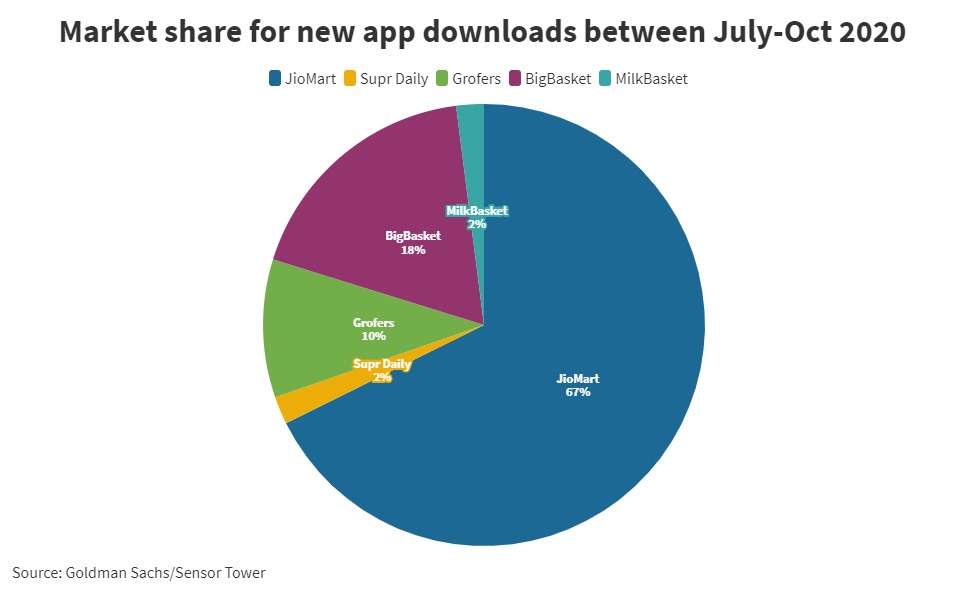
While other entrenched players like Big Basket and Grofers, who have been around for much longer, still have 7-8 times more app downloads, the rise of JioMart in the last six months only reflects the speed at which Ambani has tried to push his ecommerce dream. Since its launch, in every three downloads of any online groceries app, two of them have been the one from the house of Reliance Industries (RIL).

Mukesh Ambani is taking e-tail by storm⁠ — JioMart already has more daily active users than BigBasket and Grofers
BI India/Flourish


JioMart in India sees competition from many players who have existed and dominated the Indian e-commerce market for a long time – including the likes of Amazon and Flipkart. And so, as Ambani, Asia’s richest man, threw his hat into this ring, he decided to go all out: both in the big cities of India and beyond.

JioMart operates with an omnichannel flow where it has tied up with kirana stores (mom-and-pop stores) and also uses inventory from Reliance Retail outlets. Ambani’s e-commerce bet made a soft launch in December 2019 in select areas of Thane, Navi Mumbai, and Kalyan.

But as the coronavirus lockdown began and the opportunities in e-grocery became more evident, JioMart was quick to act and expanded to over 200 cities. This fast growth across India has given JioMart an early-mover advantage in India’s smaller towns, say analysts at JP Morgan.


Given the progress of JioMart in the first year, analysts at JPMorgan peg that Reliance’s e-commerce business may earn an annual revenue of over $59 billion and the net worth may hit $145 billion in the next ten years.

A Goldman Sachs report from November 2020 had pegged this omnichannel capability ⁠— using different channels for distribution, both online and offline ⁠— as the reason for JioMart’s growth. “India has 10 million kirana stores, which account for 90% of grocery retail in the country. JioMart has already launched in more than 200 cities, leveraging Reliance Retail’s store network, with kirana partnerships across 20 cities,” said the Goldman Sachs report.

JioMart is not just stretching far and wide, it’s also building strength via partnerships and acquisitions

Ambani is not just going for geographic expansion but he is also on a spending spree to boost JioMart’s offerings to its customers. According to JPMorgan, JioMart’s stock keeping units (SKU) is only second to Big Basket. However, the comparison didn’t include players like Flipkart, DMart and other new entrants like Swiggy and Zomato.


JioMart, with access to the deep pockets of one of the world’s richest man – Mukesh Ambani, has managed to successfully partner up with another of the world’s richest man – Facebook founder Mark Zuckerberg. Facebook pumped in $5.7 billion into Reliance Jio in April 2020, with WhatsApp’s integration with JioMart being a prime focus of the deal.

It’s set to be a win-win for both Ambani and Zuckerberg – where Reliance can take advantage of WhatsApp’s 400 million user base to acquire more customers. On the other hand, WhatsApp Pay, Facebook’s debut in the payments segment, will benefit from integrating with JioMart for payments.

Another early acquisition made by the company was that of the Mumbai-based Grab-a-Grub. In 2019, Reliance pumped in $15 million for 83% stake in the hyperlocal delivery startup. Reliance has also acquired online pharmacy company NetMeds, picked up a stake in online lingerie retailer Zivame, and online furniture retailer Urban Ladder, all of which could further bolster its e-commerce foothold.


The acquisition of Kishore Biyani’s Future Retail for almost ₹25,000 crore also gives JioMart access to BigBazaar stores across the country as well. However, Ambani and Biyani are in a legal battle with Amazon that has challenged the deal both in India and abroad.

Thursday, October 15, 2020

7:30 PM

Why Biyani had to sell Future Group to RIL

 Biyani's 'very honest' admission of why he had to sell Future Group to RIL

Company did 'too many acquisitions' and when Covid-19 struck it lost nearly Rs 7,000 crore revenue, says retail tycoon.

Future Group founder Kishore Biyani on Wednesday said the homegrown retail major lost nearly Rs 7,000 crore revenue in first three-four months of the COVID-19 pandemic due to closing of stores, which led him to sell his business to Reliance Industries.


In August this year, billionaire Mukesh Ambani's Reliance Industries announced acquisition of retail and wholesale business and the logistics and warehousing business from the Future Group as going concerns on a slump sale basis for Rs 24,713 crore.


"We got into a trap to be very honest with COVID-19. In the first 3-4 months, we lost nearly Rs 7,000 crore of revenue," Biyani said at the Phygital Retail Convention.


There was no way the company could have survived losing such an amount, he said, adding the problem is rent doesn't stop, interest (on debt) doesn't stop.


"We did too many acquisitions in the last six-seven years... I thought there was no other answer but to exit," he stated.


He said for retailers the worst is yet to come.


"We have designed business to be profitable at 90 percent of our targets. In any scenario... we will not be able to touch 70-80 per cent (of target)... If you look at long-term planning 5 to 10 years -- it will not be easy for physical stores," he said.


In August this year, billionaire Mukesh Ambani's Reliance Industries announced acquisition of retail and wholesale business and the logistics and warehousing business from the Future Group as going concerns on a slump sale basis for lumpsum aggregate consideration of Rs 24,713 crore.


Through the deal made in August with Reliance Industries, the Ambani led firm will acquire Future Retail that owns the BigBazaar that sells everything from groceries to cosmetics and apparel, and Future Lifestyle Fashions Ltd that operates fashion discount chain Brand Factory.


While Reliance will take over Future Consumer, which sells food, home and personal care products, Future Group's financial and insurance business is not part of the deal.


Future Retail operated 1,550 stores. Its flagship brands BigBazaar, FBB and Foodhall, Easyday, Heritage Fresh and WHSmith. Future Lifestyle Fashion operates 354 stores.


Investment from Reliance would help Future's founder Biyani pare debt.


Last week, US online retailer Amazon slapped a legal notice on Future Group, alleging that the retailer's Rs 24,713 crore asset sale to Reliance Industries violated an agreement with the e-commerce giant.


"We have initiated steps to enforce our contractual rights," a spokesperson for the Seattle-based e-commerce giant said. "As the matter is sub-judice, we can't provide details."


Amazon last year bought a 49 per cent stake in one of Future's unlisted firms, Future Coupons Ltd, with the right to buy into flagship Future Retail after a period between 3 and 10 years. Future Coupons owns a 7.3 per cent stake in Future Retail.


In August this year, Future reached an agreement to sell its retail, wholesale, logistics and warehousing units to Reliance.


The deal is awaiting regulatory approvals.