Ecommerce Business and Investments
Sebi slaps Rs 7 lakh fine on entity for misusing clients’ fund
The amount of misuse ranged from 43 per cent to 70 per cent of the funds of credit balance clients, Sebi said in an order.
Stock market regulator Sebi on Wednesday slapped a penalty of Rs 7 lakh on Asit C Mehta Investment Intermediaries Ltd for misusing clients’ funds and other violations.
Sebi had conducted an inspection of the books of accounts, documents and other records of the entity during April 1, 2012 to September 30, 2015 period.
Further, a multi-theme inspection was also conducted on September 30, 2015, October 13-15 and October 28, 2015 and December 27, 2016.
During the inspections, the regulator observed that the noticee (Asit C Mehta Investment Intermediaries), as a stockbroker, had misused clients’ funds wherein funds of credit balance clients was used for debit balance clients and for its own purposes.
The amount of misuse ranged from 43 per cent to 70 per cent of the funds of credit balance clients, Sebi said in an order.
According to the regulator, the misutilisation of clients’ funds is serious in nature as the misuse ranged from Rs 12.15 crore to Rs 31.01 crore.
The watchdog also noted that the broker had not settled the account of its active clients within the stipulated time period.
Accordingly, it slapped a fine of Rs 7 lakh on Asit C Mehta Investment Intermediaries for the violations.
In a separate order passed on Tuesday, Sebi imposed a fine of Rs 3 lakh on Embassy Property Development Pvt Ltd for disclosure lapses.
Embassy Property Development failed to make timely disclosures regarding the financial results of the company for the half year ended March 31, 2019 to the exchange. This was in violation of the provisions of LODR (Listing Obligations and Disclosure Requirements) Regulations.


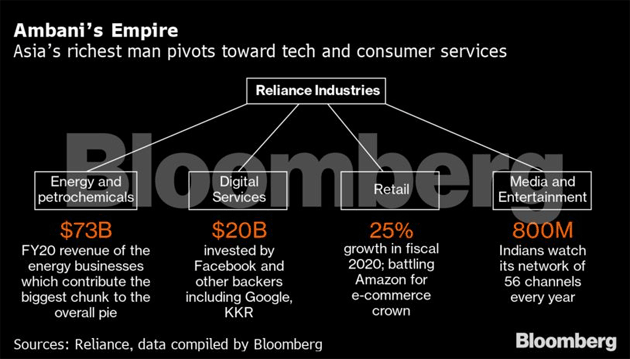
Mukesh Ambani spent much of 2020 convincing Facebook Inc., Google and a clutch of Wall Street heavyweights to buy into his vision for one of the world’s most ambitious corporate transformations.

One important difference between missing the ITR filing deadline last year and missing it - December 31 - this year is that you will have to pay a penalty of Rs 10,000 this time, unlike last year when the penalty for belated ITR filing within a few months of missing the deadline was only Rs 5000. However, this penalty or late filing fee will only be applicable if your net total income (i.e. income after claiming eligible deductions and tax exemptions) exceeds Rs 5 lakh in the financial year for which the ITR is being filed. If your net total income does not exceed Rs 5 lakh in the financial year, then late filing fee will be Rs 1,000.
(This story originally appeared in on Dec 29, 2020)

Calendar 2021 will have 14 market holidays, including five extended weekends because of a holiday falling either on Friday or Monday, data compiled from BSE suggests. The list counts the special shortened one-hour ‘Muhurat trading’ session on Diwali as a market holiday.
Calendar 2020 had fewer market holidays at 12, but more extended weekends at nine.
The first holiday for the bourses in 2021 would be on January 26, a Thursday, when the market would be shut for Republic Day. Bourses would observe no holidays in February and June.
There are two market holidays in March – Mahashivratri on March 11 and Holi on March 29. Holi, in this case, would be an extended weekend, as the holiday falls on a Friday.
April will have three market off days: on April 2 on account of Good Friday, April 14 for Dr Baba Saheb Ambedkar Jayanti and April 21 for Ram Navami.
Eid-Ul-Fitr (Ramzan Id) on May 13 would be the sole market holiday for May, Bakri Id on July 21 for July and Muharram on August 19 for August.
Towards the latter part of the year, Ganesh Chaturthi falls on September 10 and Dussehra on October 15, which would be extended market holidays.
The biggest extended holiday would be during Diwali.
A special shortened trading would take place in an otherwise market holiday on November 4, Thursday, account of Diwali. The market would be shut on November 5, Friday, on account of Diwali Balipratipada, followed by regular trading holidays on Saturday and Sunday. Gurunanak Jayanti would also fall on a Friday, on November 19.
Christmas next year falls on a Saturday, which is a normal market holiday.
The biggest bets of retail investors failed to deliver strong returns in Calendar 2020, even when the equity benchmarks are ending the year at record highs.
Investors holding shares worth up to Rs 2 lakh bought additional stakes of 9.5-23 percentage points in 10 of the BSE500 companies during the first three quarters of the year.
All but Laurus Labs delivered poor returns: seven of them ended up eroding up to 77 per cent of investor wealth; two delivered a tepid return of 3 per cent each. In comparison, BSE Sensex gained 15 per cent for the year.
Kishore Biyani’s Future Retail eroded 77 per cent of retail investors’ wealth during the year. Retail investors held 25.09 per cent stake in this company as of September 30 compared with 2.22 per cent held on December 31, 2019. Future Consumer, another Biyani stock, plunged 62 per cent during the year. Retail investors held 20.33 per cent stake in this stock as of September quarter, compared with 6.77 per cent held on December 31, 2019.
In August, Future Group said Reliance Industries, through its retail arm, would acquire the company’s retail & wholesale business as well as the logistics & warehousing businesses on a slump sale basis for Rs 24,713 crore. Amazon, a stakeholder in Future, is looking to block that deal, saying the Indian retailer violated a contract by agreeing to the sale to a rival controlled by billionaire Mukesh Ambani.
Shares of Raymond have slumped 49 per cent so far in 2020. Retail investors raised stake in this diversified firm by 7.63 percentage points to 25.31 per cent from 17.1 per cent. The Raymond group operates across segments such as FMCG, engineering and prophylactics besides in textile and apparel.
“This year was a total washout. I don't think we will meet FY20 levels, but going forward, a lot of companies have reshaped themselves. They have set new benchmarks and there is a lot of opportunities for the companies that survived this pandemic. They will come out much stronger," Raymond's Chairman and Managing Director Gautam Hari Singhania told PTI earlier this month.
Equitas Holdings declined 38 per cent year to date, as SME/MFI businesses faced various challenges at the operating levels in the wake of the Covid pandemic. The stock has recovered strongly in the last two months on faster-than-expected recovery in business.
Indiabulls Housing Finance (down 35 per cent), Chennai Petroleum Corporation (down 16 per cent) and The South Indian Bank (down 11 per cent) are three other biggest retail bets that failed to deliver for the year. Two stocks -- NCC and PTC India -- delivered 3 per cent each, while Laurus Labs delivered a solid 384 per cent return.
Analysts are mixed on Indiabulls Housing Finance. The company has lost mortgage market share in last one year. The housing finance company had a 2.2 per cent market share as of September 2020 compared with 3.7 per cent held in the year-ago quarter. The scrip had one 'buy', one 'underperform' and one 'hold' ratings on the publicly available Reuters Eikon database as of Friday.
South Indian Bank had four 'buy', one 'outperform', two 'hold', one 'underperform' and one 'sell' rating on the same database. CPCL had one 'buy' and one 'outperform' ratings.
NCC, meanwhile, has seen robust order flows so far in FY21, surpassing its annual guidance of Rs 10,000 crore. Its standalone order backlog stood at Rs 28,000 crore in September while the current unadjusted backlog stood at Rs 32,800 crore, 4.7 times the trailing 12-month revenues. Recovery of past dues is seen as a key trigger for the stock. PTC India has one 'buy' and one 'outperform' ratings, as per the Reuters database.
Analysts remain positive on Laurus Labs on superior execution in the antiretrovirals segment, strong chemistry skill set in the contract development and manufacturing business, the addition of new molecules in the API segment and cost efficiencies. Retail holding in this stock stood at 15.89 per cent at the end of September against 6.37 per cent as of December 31.
Washington: Setting the tone for the US-China ties for the next four years, President-elect Joe Biden on Monday said that Washington needs to build a coalition of like-minded nations to confront Beijing.
"As we compete with China to hold China's government accountable for its trade abuses, technology, human rights and other fronts, our position would be much stronger when we build coalitions of like-minded partners and allies that make common cause with us in defence of our shared interests and our shared values," Biden said following his briefing with national security and foreign policy agency review team members.
Under the Donald Trump administration, ties between the two countries had deteriorated over issues such as human rights violations in Xinjiang, encroachment on the special status of Hong Kong, accusations of unfair trade practices by Beijing, lack of transparency concerning the pandemic and China's military aggression in various parts of the world.
Biden said partnering with other democracies on China would "more than double" the US economic leverage over the country.
"We are almost 25 per cent of the global economy on our own, but together with our democratic partners, we more than double our economic leverage," he said.
On any issue that matters to the US-China relationship, Biden said, "We are stronger and more effective when we are flanked by nations that share our vision for the future of our world."
In a bid to meet the security challenges against China and Russia, Biden said the US must make reforms to put itself in the strongest possible position.
"That includes modernising our defence priorities to better deter aggression in the future, rather than continuing to over-invest in legacy systems designed to address the threats of the past," the President-elect said.
"And we need to close the gap between where our capabilities are now and where they need to be to better deter, detect, disrupt, and respond to these sorts of intrusions in the future," Biden added.
Biden is set to occupy the White House in January next year.
On SBI
SBI has been subjected to all kinds of uncertainties. They had to bail out YES Bank. There was a fear that SBI would probably need to bail out other PSU banks too. Rajnish Kumar, the previous CMD did a fantastic job in guiding SBI through that whole process and now the new CEO is an old hand and knows the system very well, which is very important for a PSU bank and provides some amount of continuity.
We are now entering into a period of peak provisioning. We know the maximum losses that can happen and that helps in provisioning and in the tier I capital ratios and therefore loan growth. When all these things fall into place, then valuations begin to matter. Valuations anyway are on its side as it is an extremely cheap bank. It will do very well in the coming year.
On real estate as a contrarian play
2020 has been pretty much affected by Covid. No sales were possible before the last two months for obvious reasons and now sales have started again as the economy unlocks and people begin to go out. There is a sufficient amount of unsold inventory out there. Companies including DLF have restructured, reduced their debt and are now showing increasing willingness to sell at a lower price than they were holding back in the previous year. This is going to be a big theme and will apply to other sectors as well.
2021 will be a year of transformation and the companies that are transforming themselves such as DLF, will see increased traction.
On how much more can TCS NSE 0.04 % & Infosys NSE 0.81 % go
If you look at the PEs in the context of earnings, these companies are still trading pretty much in the 20s and for an earnings growth which is going to accelerate with good visibility going into the next couple of years, then PEs will look slightly more palatable.
Second, ROEs of these companies have been improving because lower expenses, greater productivity and higher ROE support greater profitability which supports a higher multiple. Against that backdrop, the multiples are clearly fine for the frontline players and companies as big as TCS, Infosys and HCL Technologies NSE 1.53 %. These companies are still growing earnings north of 15% earnings growth and with the potential for a further earnings upgrade.
As I believe that 2021 is the year of transformation, a transformation in the companies’ business model which improves their margins even in a limited sense, will support higher multiples and earnings will come back over the next couple of years. I think IT will make steady 15-20% returns per year going to the next couple of years at least.
On QSR/consumption space
QSR as a space will continue to do very well simply because coming out of the lockdowns, people are increasingly ordering in more or going out. All these factors will help consumption companies. For example, the Burger King stocks were running ahead of themselves in terms of fundamentals. These are great companies with good valuations at the time of listing but Bectors Food now trades at a very high multiple. Easy money has been made in those stocks but on the other hand, Jubilant Foodworks and Westlife still look good. There is still additional room for returns in the coming weeks and months.